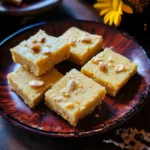
Ingredients
- Full-Fat Milk Powder (Dairy Whitener): 2 cups (approximately 200-220g). This is the star ingredient, providing the milky base and structure. Full-fat yields a richer, creamier burfi.
- Ghee (Clarified Butter): ½ cup (approximately 100-110g). Ghee adds richness, a characteristic nutty aroma, and helps in roasting the milk powder.
- Granulated Sugar: 1 cup (approximately 200g). This provides sweetness and, when cooked to the right consistency, the structure for the burfi.
- Whole Milk (or Water/Heavy Cream): ½ cup (120 ml). This is used to make the sugar syrup. Using milk can add extra richness, while water keeps it classic. Heavy cream will make it even richer.
- Cardamom Powder: ½ to 1 teaspoon, freshly ground if possible. This imparts the classic aromatic flavor. Adjust to your preference.
- Chopped Nuts (Pistachios, Almonds): ¼ cup, for garnish and added texture. You can also mix some into the burfi itself.
- Optional: Saffron Strands: A few strands, soaked in a tablespoon of warm milk, for color and a luxurious aroma.
- Optional: Edible Silver Leaf (Vark): For a traditional festive decoration.
Instructions
- Preparation is Key:
- Grease a thali (plate with a rim), a square baking tin (approx. 8×8 inches), or a tray with a thin layer of ghee. This will prevent the burfi from sticking and make it easier to remove once set.
- Chop your nuts (pistachios, almonds) if you haven’t already. Keep them aside for garnish.
- If using saffron, soak the strands in 1 tablespoon of warm milk and set aside.
- Roasting the Milk Powder:
- In a heavy-bottomed pan or kadai, add the ½ cup of ghee and let it melt over low heat.
- Once the ghee has melted, add the 2 cups of milk powder.
- Stir continuously on low to medium-low heat. This is a crucial step. You need to roast the milk powder until it turns a very light golden or pale beige color and emits a pleasant, nutty aroma. This can take anywhere from 8-12 minutes.
- Be vigilant during this stage, as milk powder can burn very easily. If it burns, the burfi will have a bitter taste. Keep scraping the bottom and sides of the pan.
- Once roasted to perfection (aromatic and slightly changed in color), remove the pan from the heat and transfer the roasted milk powder to a separate bowl or plate to prevent further cooking from the residual heat of the pan.
- Preparing the Sugar Syrup:
- In the same pan (wipe it clean if there are any browned milk powder bits) or a different clean saucepan, add the 1 cup of granulated sugar and the ½ cup of whole milk (or water).
- Place the pan over medium heat and stir until the sugar dissolves completely.
- Once the sugar has dissolved, bring the mixture to a boil. Continue to cook, stirring occasionally.
- You are looking for a “one-string consistency” (ek taar chashni). To check this:
- Carefully take a tiny drop of the syrup between your thumb and forefinger (ensure it has cooled slightly to avoid burns).
- Gently pull your fingers apart. A single thread or string should form and hold its shape for a second before breaking.
- Alternatively, drop a little syrup onto a small plate. Let it cool for a few seconds. Tilt the plate; the syrup should not be too runny. When you touch it with a finger and pull away, it should feel sticky and form a short thread.
- This stage is critical. If the syrup is undercooked, the burfi won’t set properly. If it’s overcooked, the burfi will become hard and crystalline. It usually takes about 5-7 minutes after the boil to reach this consistency.
- Combining and Cooking the Burfi Mixture:
- Once the one-string consistency is achieved, immediately reduce the heat to low.
- Add the roasted milk powder to the sugar syrup all at once.
- Stir vigorously and continuously to break any lumps and combine everything well. The mixture will start to thicken.
- Add the ½ to 1 teaspoon of cardamom powder and the soaked saffron milk (if using). If you want to add some chopped nuts into the burfi itself (not just as garnish), add them now.
- Continue to cook on low heat, stirring constantly, for another 3-5 minutes. The mixture will start to leave the sides of the pan and come together like a soft, non-sticky dough or mass. It should look glossy.
- To test if it’s ready, you can take a tiny portion and try to roll it into a small ball once it’s cool enough to handle. It should form a non-sticky ball. Don’t overcook at this stage, or the burfi will become chewy.
- Setting the Burfi:
- Quickly transfer the burfi mixture to the prepared greased thali or baking tin.
- Spread it evenly using the back of a ghee-greased spoon or a spatula to a thickness of about ½ to ¾ inch.
- Sprinkle the chopped pistachios and almonds (and any other desired nuts) evenly over the top. Gently press them into the burfi with the spatula so they adhere well.
- If using edible silver leaf (vark), apply it carefully now while the burfi is still warm and slightly sticky.
- Cooling and Cutting:
- Let the burfi cool down completely at room temperature. This can take anywhere from 2 to 4 hours, or even longer depending on the ambient temperature. Avoid refrigerating it to set, as this can sometimes make it too hard or change the texture.
- Once it’s set and firm to the touch, use a sharp, ghee-greased knife to cut the burfi into desired shapes – squares, diamonds, or rectangles.
- Gently lift the pieces from the tray. If they are a bit difficult to remove, you can slightly warm the bottom of the tray for a few seconds.
Nutrition
- Serving Size: One Normal Portion
- Calories: 150-180 kcal